![logo-modified.png]](https://support.skinconsult.com/hs-fs/hubfs/logo-modified.png?width=40&height=40&name=logo-modified.png)
What is an aerosol?
An aerosol can is a form of packaging. It consists of a container made of tin, aluminum or glass. The contents of the aerosol consist of an active ingredient and a propellant. When the valve is pressed, the propellant forces the active substance out in the form of a mist, foam or powder. The aerosol can as a form of packaging offers many possibilities, it may be easier to apply your cosmetic, and is very well dosable.
Legislation for cosmetics as aerosols
Cosmetics always have to comply to the Cosmetic Regulation EC 1223/2009 in Europe, but in the case of an aerosol packaging the cosmetic also has to comply to the Aerosol dispensers Legislation 75/324/EEC. This has impact on information we need for the Cosmetic Safety Assessment Report. Use our checklist to make sure you have all extra the documentation needed and your product label is in compliance.
Product documentation checklist:
[ ] Documentation on the packaging material grade, this documentation should state that packaging may be used for cosmetics
[ ] Optional: CAD, a technical drawing of the packaging
[ ] MSDS of the endproduct
[ ] Information on the pressure of the pressurized container should be described or tested in a water-bath.
Product label checklist*:
[ ] Hazardsymbols that are mentioned in the MSDS
[ ] Hazard phrases that are mentioned in the MSDS
[ ] Conformity marking 'reverse epsilon' referred to as '3'
[ ] Maximum content of the spray can to be framed
[ ] Instructions of use example: "Shake well before use. When using, keep the spray can upright and spray evenly. Spray distance approx. 20 cm.”
*This is an addition to the mandatory parts for labelling for EC 1223/2009.
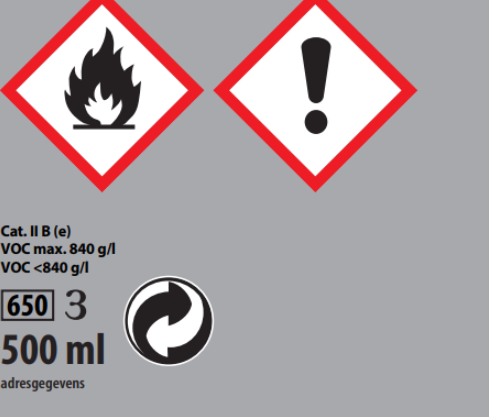
Reference picture: Dutch Aerosol Association