![logo-modified.png]](https://support.skinconsult.com/hs-fs/hubfs/logo-modified.png?width=40&height=40&name=logo-modified.png)
What is a Product Information File?
A (Product Information File) PIF is a document that describes your product and proves its compliance to EC 1223/2009 - the European Committee’s legislation on cosmetic product safety.
There are many parts to a PIF which may seem overwhelming at first. Rest assured we will explain the different sections and
by the end of this article you will understand every aspect of the report.
Where can I find my finalized PIF?
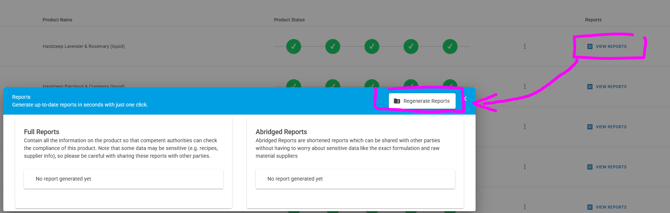
The PIF can be found under each product in your question by clicking on “view reports”. If it's your first time viewing this report, you need to generate it so that it contains all up-to-date documentation.
If you have full access to the reports, you can actually download two different versions of the reports, namely the full report and the abridged report. The abridged report is a report that does not include sensitive information like raw materials and suppliers so that you can freely share this report without spilling all your secrets.
Part 1 - Product administration
Product administration states all the parties involved in the making of the product as well as determining its final safety and compliancy to EU legislation.
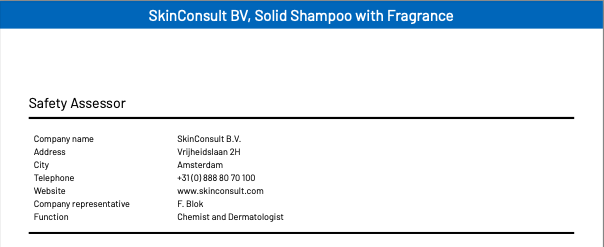
The manufacturer, packager and responsible person are all parties that are required to know to ensure the safety of the product. The company name as well as (web-)address will appear in these sections. Therefore, if you switch manufacturer or change the name of your company (and thus the responsible person changes), you are obligated to let SkinConsult know.
The safety assessor of your PIF will always be SkinConsult. It also includes our contact information should it be required by any party in the future.
Part 2 - Product description
This part of your PIF describes your product, as well as application and exposure. It describes the product type and safe use.
This part of the PIF may come in handy if a client calls with concerns over the product - if irritation occurs it states reasonable advice to give.
It also includes the IFRA category that your product type falls under. Even if your product does not contain any scenting ingredients (i.e. perfumes and essential oils) this will still be a part of the report. Please read our article on IFRA amendments to find out more about various IFRA amendments.

Part 3 - Ingredient Declaration
This is the agreed upon INCI declaration (ingredients list) used by the responsible person on their packaging/artwork/label. Both SkinConsult and the Responsible Person (you!) must agree on the declaration. This list is always made based on the raw material formula and documentation - please see this page for more information on how SkinConsult determines the correct INCI declaration for your product.

Part 4 - Product type and Exposure
This is essentially a short summary of the previous parts of the PIF. A short description of the product type as well as the expected (safe) exposure to the product under regular use. Regular use entails that the client follows the instructions of use as described on the packaging/artwork/label.
Part 5 - Ingredient Formula INCI
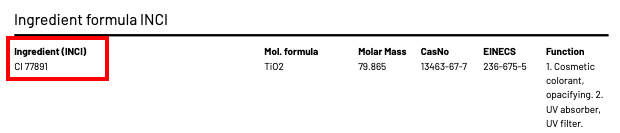
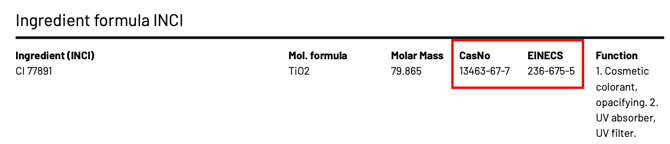
This part of the PIF states each of the ingredients (INCIs) in your product with some essential information about the ingredient. For example let’s take a look at this first ingredient in our shampoo, with the name CI 77891.
The second and third column describe chemical features of the ingredient. The molecular formula is short-hand for the chemical structure of the ingredient, and molecular mass is the chemical weight it holds. These are important because they substantiate why an ingredient can or cannot be absorbed.
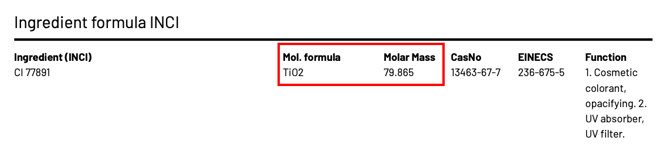
The fourth and fifth column are named CasNo and EINECS. The CasNo stands for CAS Number, which is a unique identifier of each ingredient. Every chemical substance described in scientific literature has unique CAS number(s), which is agreed upon by the Chemical Abstracts Service. This includes any cosmetic ingredient. The EINECS number holds a similar function, except it was assigned by the European Commission.
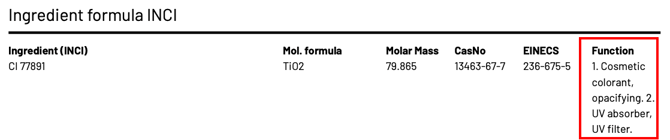
Finally, the sixth column describes all the possible functions the ingredient may have. For example, CI 77891 can be both a cosmetic colourant and a UV filter (and thus important in products with a SPF). Please note that the PIF does not distinguish between the function of the ingredient in your product. For example, CI 77891 in this product is only used as a colorant as no shampoo requires SPF, but both functions are mentioned.
Part 6 - Ingredient formula raw materials/Qualitative composition of product
The sixth part of the PIF is similar to the fifth, but rather than giving information for each ingredient it describes each raw material (RM).
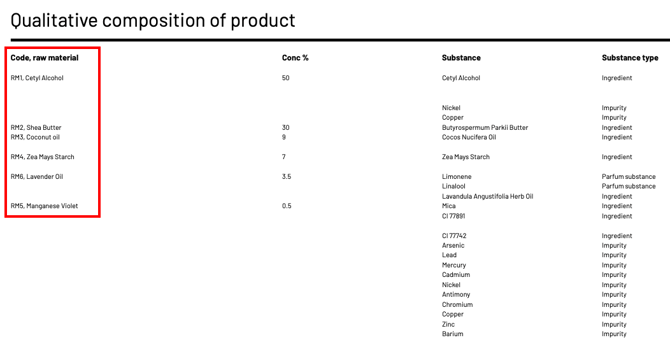
The first column contains the RM code and name. Please see our page on Raw Material Formulas to find out more about raw material codes and why they are essential. If you have not assigned any codes to your raw materials, this part will be blank.
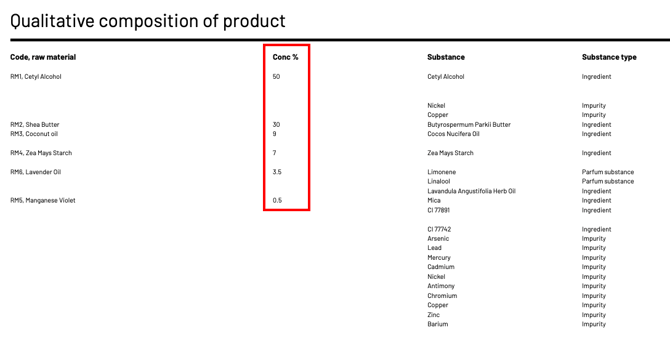
The second column states the concentration of each product. The total of this column may be more than 50% if your raw material formula was given in ranges. When this is the case SkinConsult uses the highest percentage in order to ensure safety of the cosmetic product. If your product is safe for all ingredients at the highest concentration it is sure to be safe at a lower concentration.
Please be sure that you trust who you share your PIF with, as your unique formula is shown here!
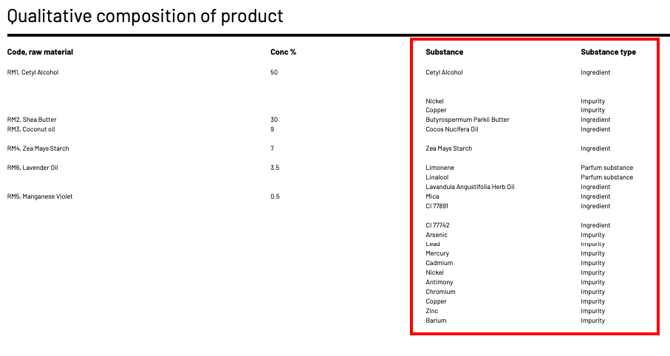
The next 2 columns describe the components (substances) of each raw material, as well as the type. All of this information has been gathered from the raw material documentation you have delivered to us. There are different types of substances:
- An ingredient is the actual component of the raw material.
- An impurity is a technically unavoidable contaminant.
- A perfume substance is a perfum allergen.
- A component may be a constituent of the raw material, but not mentioned in the ingredient list. For example, if an ingredient is diluted in oil as part of the manufacturing process, but the oil is not a final ingredient in the raw material.
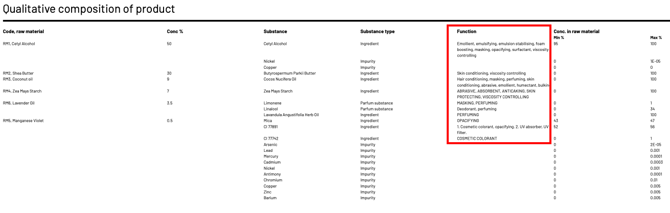
The fifth column once again describes the function of each raw material. Please see above in Part 5 - Ingredient Formula INCI for more information.
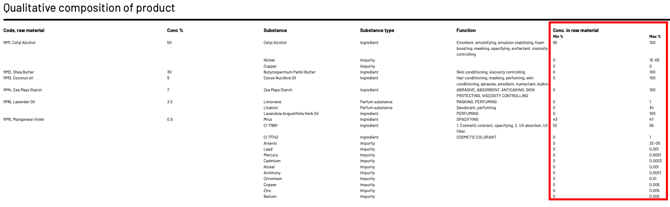
The last 4 columns describe the concentrations of each raw material. The first 2 state the minimum % of each INCI/Ingredient in each raw material. The minimum concentration is often 0%, this is standard.
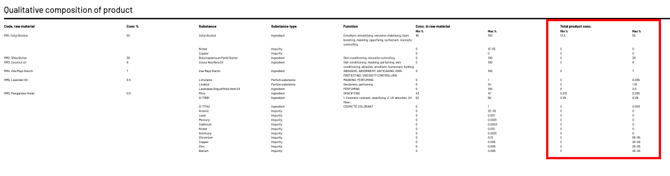
The final 2 columns state the minimum % of each INCI/Ingredient in your final product. The minimum concentration is often 0%, this is standard. Essentially, this is covers all of the Raw Materials and INCIs associated with their respective raw material. This breakdown offers a good overview of the final product.
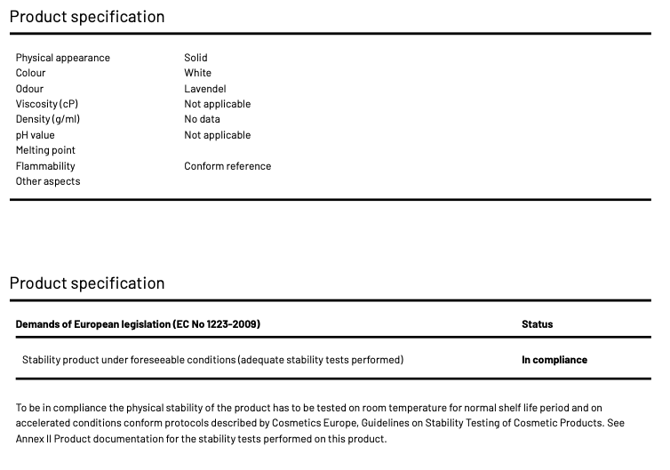
Part 7 - Product Specification
This offers an overview of the physical and chemical characteristics of your product. The pH may be “not applicable” if your product:
-contains no water
-is a solid
It also states whether or not compatibility testing for your product has taken place. For more information please look at our article on Annex II.
Part 8 - Manufacturing method
The manufacturing method details the process how your product is made. This can be a high-over flowchart, or a very detailed step-by-step checklist. This depends a lot on the complexity of your product. The manufacturing method allows you (and authorities) to more easily find the root cause if a defective product is manufactured.
Part 9 - GMP Compliance
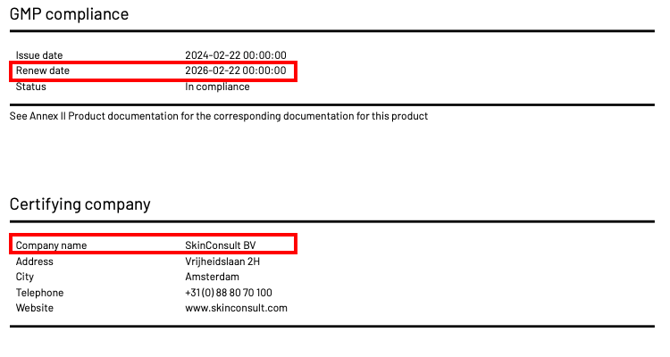
GMP compliance is essential for every single manufacturer that produces cosmetics according to EC 1223/2009 (please see our page on GMP compliancy for more information). Please note that GMP compliancy always has an expiration date, standard is 2 years after the certificate has been awarded to the manufacturer.
This page also states who the certifying party is. If the manufacturer is self-GMP compliant then their name will be the Certifying Company. If your manufacturer has been third-party certified for GMP, then a different company name and details will be the Certifying Company.
Part 10 - Product Stability
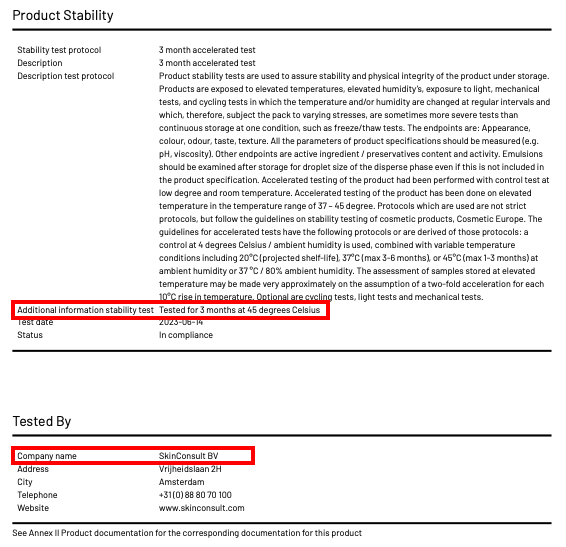
Part 10 describes the methodology of the Stability testing that took place for your product. It describes the testing method and states the testing company. The document you delivered in order for us to confirm your product underwent and passed stability testing will be found in Annex II. Should you require it, you can download this via the SkinApp in the same place you downloaded the PIF.
Part 11 - Microbiological Testing
This part of the PIF details which microbiological test protocol your product underwent (e.g KoKo, ISO 11930, European Pharmacopeia) as well as the testing date and what party performed this test.
If your product did not have to undergo challenge testing (because it does not contain water or is a solid) you will still see the following information in your report:
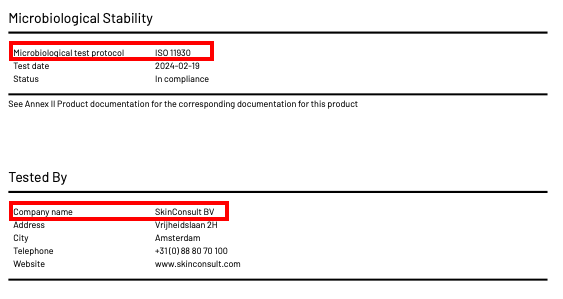
The supporting or evidentiary documentation can be found in the Annex II document.
Part 12 - General composition of the product
Each raw material has general information that is required - these aspects are described in Part 12 of the PIF. We can read about the supplier and manufacturer of each raw material, as well as their grade. Each product must at least be suitable for cosmetics, food and pharmaceutical grades are “higher” and thus also acceptable.
Column 6, states that the reader of the PIF must look at the MSDS of each raw material in order to find out information about the physical information of the raw material (except the physical state of the product). This part 9 contains a lot of detail, therefore SkinConsult prefers that the reader views this report. It is also a reason why the MSDS is required for each raw material (please read our page on the Raw Material Protocol for more information).

Part 13 - Raw materials: Supplier, manufacturer
This refers to Annex I which can be found where you downloaded the PIF. This is to keep the PIF nice and tidy to allow authorities to more easily check your product information.
Part 14 - Packaging Material
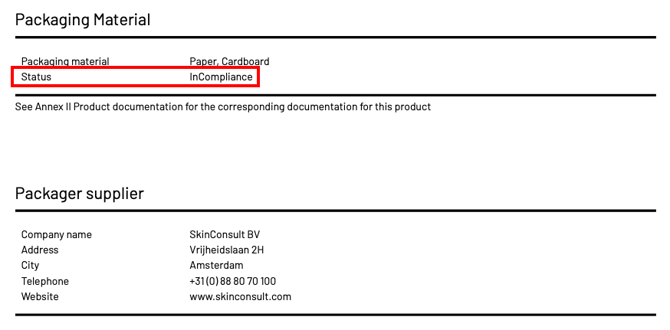
The Packaging material describes what (material) your packaging is made of - for example PET, rPET, paper, or glass.
The status of “In Compliance” refers to the fact that the supplier has declared the packaging is suitable for cosmetic use.
Part 15 - Packaging compatibility
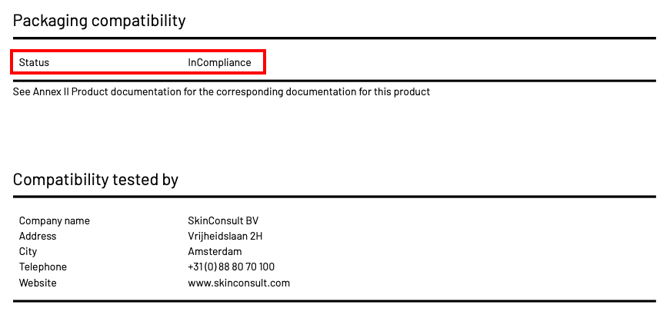
Compatibility testing is when your finalised cosmetic formula is tested in its final packaging, performed in 40 degrees Celsius for 3 months. It is often performed simultaneously with your stability test. (See our page on Compatibility Testing for more information)
This part of the PIF states whether compatibility has been tested, and if it is approved the status will read “In Compliance”. It also states the testing party.
Part 16 - Product Label
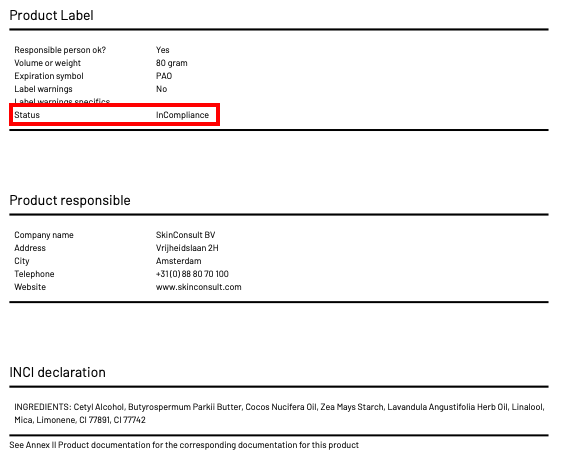
This part of the PIF gives a short summary about your label/artwork, specifically all the information required by EU law to be compliant. For example the volume or weight, expiration symbol and whether enough information about the responsible person is given. You can also find the responsible person contact information and the INCI declaration used for the product.
This does not give any information about specific claims used, however SkinConsult does check this when reviewing your artwork. If would fall under the status.
Part 17 - Product Claims and Support
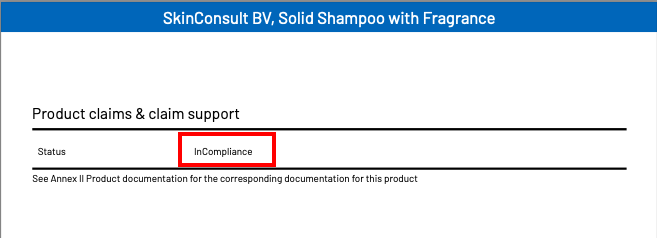
This is only relevant if you have made claims on your artwork that need additional evidence.
SkinConsult will always check the legitimacy of claims made on your label. Examples include SPF claims and product function (e.g increases collagen).
Standard claims such as “cleanses hair” for a shampoo do not require extra support.
In your PIF the status should always be “In Compliance” with extra support in the Annex II document.
Part 18 - Product beneficial effects and Clinical Information
Although it is not obligatory for most cosmetic products, some cosmetics are tested on humans to find their possible beneficial effects and relevant clinical information. Don't worry, they have given their consent. These tests may be done to support efficacy claims such as "anti-wrinkle", "hydrating" and "for sensitive skin".
Part 19 - Product Undesirable Health Effects
This part of the PIF report relates back to the company documents that are obligatory for the responsible person to fill in and send to SkinConsult. The Undesirable Health Effects statement filled in by the responsible person is reported to be complete here, as well as stating it is ultimately the obligation of the RP to be truthful and liable for this statement.
In Annex II the supporting document can be seen. The status should always be “In Compliance”. 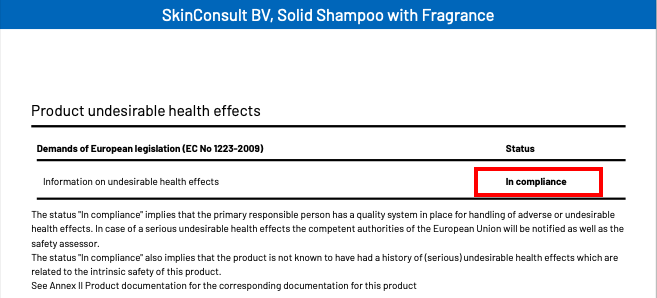
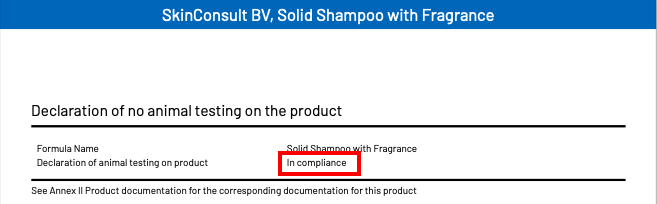
Part 20 - Declaration of no animal testing on the product
Similarly to part 19, this is a part of the company documents that the responsible person must upload in the SkinConsult app. It is a statement wherein the Responsible Person states they have never tested their final product(s) on animals.
In Annex II the supporting document can be seen. The status should always be “In Compliance”.
Part 21 - Declaration of no animal testing on individual ingredients of the product
Part 21 of the PIF relates to all the raw material documentation collected from the raw material suppliers. Each raw material requires a statement from the supplier wherein they declare their product has not been tested on animals for cosmetic purposes since (latest) March 2009. This part of the PIF explains that this has been completed for all raw materials in your product, and therefore you comply with another section of EC 1223/2009.
It also states all the raw materials used for your product and emphasises that this document has been collected for all raw materials.
In Annex II the supporting document can be seen. The status should always be “In Compliance”.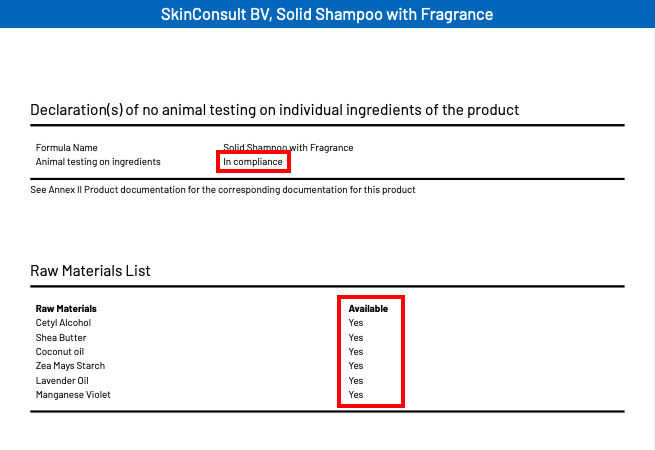
Part 22 - Product changes & product history
This part of the PIF states whether any changes have been made to the product (for example, a different raw material is used or the artwork has been changed). This should always be “In Compliance” as if any product changes take place, SkinConsult will duplicate your request and check all your data again. This also ensures your product is up to date with the most recent legislation, and so that none of the company documents have expired. 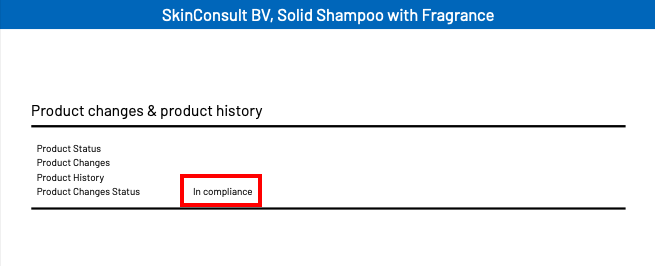
Part 23 - Registration documents
Every product placed on the European market must be notified in the Cosmetics Products Notification Portal (CPNP), an initiative from the European Commission. In order to complete your PIF this step must be undertaken. SkinConsult can happily perform the CPNP notifications for your products.
If you want to notify your own products on the CPNP, please see our instructions on how to perform CPNP notification here.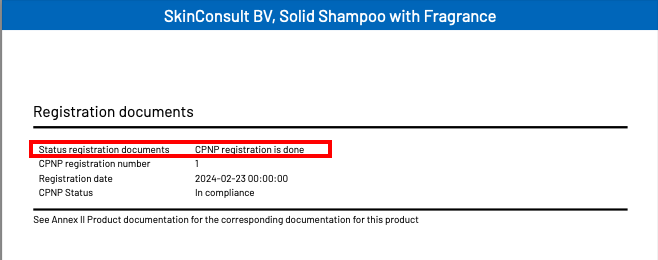
Part 24 - Information Of Public Access
Certain information about the product should be made readily accessible to the public. This is the following according to EC 1223/2009 art. 21:
Access to information for the public
Without prejudice to the protection, in particular, of commercial secrecy and of intellectual property rights, the responsible person shall ensure that the qualitative and quantitative composition of the cosmetic product and, in the case of perfume and aromatic compositions, the name and code number of the composition and the identity of the supplier, as well as existing data on undesirable effects and serious undesirable effects resulting from use of the cosmetic product are made easily accessible to the public by any appropriate means.
The quantitative information regarding composition of the cosmetic product required to be made publicly accessible shall be limited to hazardous substances in accordance with Article 3 of Regulation (EC) No 1272/2008.
We hope ot have infromed you how to understand your finalised PIF report. Should you have any questions, please contact us at office@skinconsult.com
Remember, safety first!